
You don’t have to get rid of difficult thoughts and feelings before you can live a full and meaningful life. You can learn to live alongside them, while still doing what matters to you.
And why making room for difficult thoughts and feelings can help you live a fuller life
Most of us have tried to think our way out of a difficult feeling at some point. Talk ourselves out of the nerves before a presentation. Push the self-doubt down and carry on. Wait until we feel more ‘ready’ before we go for the thing we want. Sometimes that works. Often, it doesn’t, and we end up waiting for a feeling that never quite arrives.
Acceptance and commitment coaching (ACC) takes a different approach. Rather than getting rid of difficult thoughts and feelings first, it helps you carry them with you while you move towards what matters to you.
Where it comes from: the main idea of ACT
ACC grows out of Acceptance and Commitment Therapy (ACT, said as one word, “act”), developed by psychologist Steven Hayes and colleagues (Hayes et al., 2006). ACT is one of the most researched psychological approaches around. To date, the Association for Contextual Behavioral Science (2025), which supports ACT research internationally, has catalogued more than 1,500 randomised controlled trials of the approach.
The main idea is simple, even if living it isn’t:
You don’t have to get rid of difficult thoughts and feelings before you can live a full and meaningful life. You can learn to live alongside them, while still doing what matters to you.
ACT starts from the view that discomfort is a normal part of being human. Anxiety before something important, doubt when you try something new, grief when you lose something you care about. These aren’t signs that something is wrong with you. They’re often signs that you care. That you are in-fact, human.
The difficulty usually starts when we put our energy into avoiding or fighting those feelings. We turn down the opportunity, put off the conversation, or stay busy so we don’t have to notice how we feel. In the short term it brings relief. In the longer term, our lives get smaller.
ACT aims to build psychological flexibility: the ability to be present with whatever you’re thinking and feeling, and still choose actions that fit the kind of person you want to be.
The three pillars, in plain English
ACT is often described through six core processes. To make them easier to hold in mind, they’re commonly grouped into three pillars: being open, aware and engaged. Russ Harris, who has done a lot to make ACT accessible, puts it as be present, open up, and do what matters.
1. Open: making room for what you feel
This is about loosening the grip of difficult thoughts and feelings rather than battling them. It includes acceptance (letting feelings be there without a fight) and defusion (stepping back from thoughts so you can see them as thoughts, not facts or orders). “I’m going to mess this up” becomes “I’m having the thought that I’m going to mess this up.” It’s a small shift, but it gives you some distance to choose what you do next.
2. Aware: being here, now
This is about noticing what’s happening in the present moment, inside and around you, rather than running on autopilot or getting lost in the past or future. It also includes a sense of the part of you that notices: the steady perspective that can observe your thoughts and feelings without being defined by them.
3. Engaged: doing what matters
This is about getting clear on your values, the qualities you want to bring to your life, and taking committed action in line with them. Values aren’t goals you tick off. They’re more like a compass direction: “being a supportive friend” or “learning and growing” are directions you can keep moving in for the rest of your life.
So what is acceptance and commitment coaching?
Acceptance and commitment coaching takes the ideas and tools of ACT and applies them in a coaching setting. The focus shifts from treating mental health difficulties to helping people grow, perform and live in line with what matters to them.
In Acceptance and Commitment Coaching: Distinctive Features (2019), executive coach Jon Hill and clinical psychologist Dr Joe Oliver set out how the ACT model works within coaching. A few ideas run through their approach:
You’re not broken. The starting point is that you’re dealing with the normal ways human minds work, not a problem that needs fixing.
Workability over right and wrong. Rather than judging thoughts as positive or negative, the question is whether a pattern is helping you move towards the life you want.
Values guide the goals. Goals still matter, but they’re anchored in what you care about, so the motivation lasts longer than the initial burst of enthusiasm.
Practical and experiential. Sessions use metaphors, short exercises and real-world experiments, not just talk.
ACT-based approaches have also been used widely in workplaces. A review by Flaxman and colleagues (2023) found that ACT-based training at work has been shown to improve employees’ general mental health, although results for burnout are more mixed. Most of the evidence comes from ACT as therapy or training rather than coaching, and research on ACC specifically is still growing. It’s worth being honest about that.
What it can look like in practice
This is a composite example, not a real client.
Sam is a manager who has been offered the chance to present to the senior leadership team. Every time she thinks about it, her chest tightens and her mind fills with “what if I freeze?” So she keeps finding reasons to hand it to a colleague.
In coaching, we wouldn’t start by trying to make the nerves go away. Instead, we’d map it out on the ACT Matrix, one of the most practical tools in ACC, developed by psychologist Kevin Polk and colleagues (Polk & Schoendorff, 2014).
Picture a cross drawn on a page, making four boxes. On the right are the things that matter to you, and the actions that move you towards them. On the left are the difficult thoughts and feelings that show up, and the things you do to move away from them.
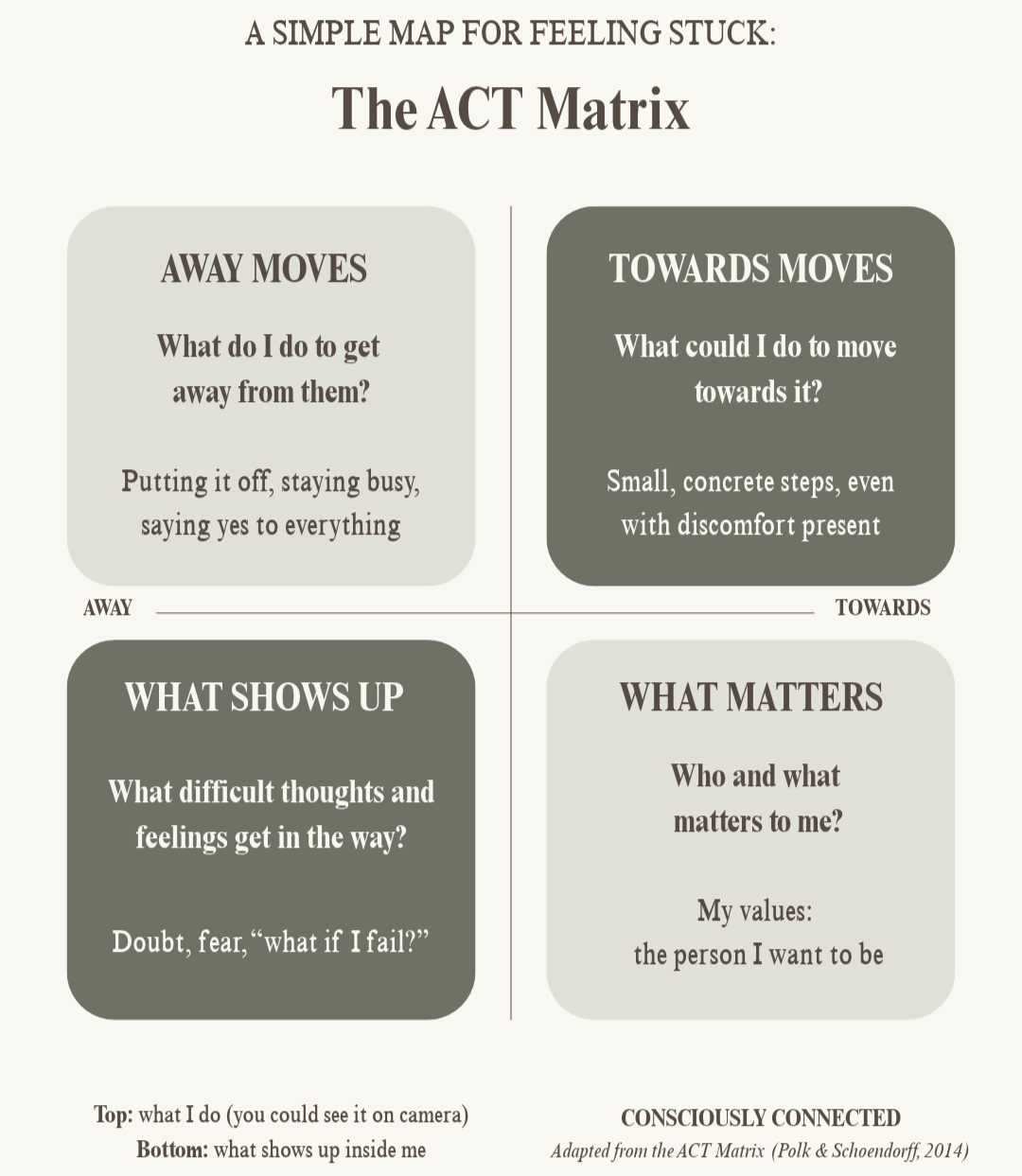
For Sam, what matters is growing in her role and being seen for the work she does. What shows up is the fear of freezing, and the thought “they’ll realise I’m not good enough.” To get away from that, she delegates, over-prepares, or says she’s too busy.
From there, we’d practise noticing the thought as a thought, make some room for the nerves, and plan one small towards move, such as presenting one slide at the next team meeting. The nerves might still come along. The difference is that they’re no longer making the decision.
Try this: your own Matrix
Away moves aren’t bad. Scrolling your phone, staying late to avoid a hard conversation, or saying yes to everything so nobody’s disappointed can all make sense in the moment. The question the Matrix asks is simply: is this working for me, in the long run, in terms of the life I want?
Take a piece of paper and draw a cross to make four boxes. Think of one area of life where you feel a bit stuck, then jot down:
Bottom right: who or what matters to you in this area?
Top right: one or two small things you could do that would move you towards that.
Bottom left: the thoughts and feelings that show up and get in the way.
Top left: what you tend to do when they show up.
Then ask yourself: if those thoughts and feelings came along with me, what’s one small towards move I could make this week?
How this shows up in my coaching
My first experience of ACT was as an Assistant Psychologist in a hospital-based clinical and health psychology service in the NHS. There, I used ACT-based approaches, under clinical supervision, to support people adjusting to and living with long-term health conditions, in one-to-one sessions and group programmes.
Something clicked when I learnt ACT. Other approaches I’d worked with were genuinely useful, but I often found them harder to apply day to day, in the moment, when things were actually happening. ACT was practical in a way that made sense to me, and I saw the same thing happen for people in sessions. I’ve been hooked ever since.
Many of the people I worked with couldn’t make their difficulties disappear. What changed was their relationship with them. I saw people go from putting life on hold until things improved to reconnecting with what mattered to them, alongside pain, fatigue or uncertainty. Seeing how much difference that made is a big part of why I now bring these ideas into coaching.
Today, I offer psychology-informed life coaching in Melbourne, and online worldwide. My approach is informed by Acceptance and Commitment Coaching. In sessions, that means getting clear on your values, noticing the patterns that keep you stuck, practising skills for handling difficult thoughts and feelings, and taking small, committed steps that fit the life you want.
ACC is coaching, not therapy. If something comes up that needs clinical support, I’ll say so and help you find the right next step.
References
Association for Contextual Behavioral Science. (2025). New ACBS milestone: 1,500 randomized controlled trials indexed. contextualscience.org
Flaxman, P. E., Prudenzi, A., & Zernerova, L. (2023). Acceptance and commitment training in the workplace. In M. P. Twohig, M. E. Levin, & J. M. Petersen (Eds.), The Oxford Handbook of Acceptance and Commitment Therapy (pp. 407–431). Oxford University Press.
Harris, R. (2019). ACT made simple (2nd ed.). New Harbinger.
Hayes, S. C., Luoma, J. B., Bond, F. W., Masuda, A., & Lillis, J. (2006). Acceptance and commitment therapy: Model, processes and outcomes. Behaviour Research and Therapy, 44(1), 1–25.
Hill, J., & Oliver, J. (2019). Acceptance and commitment coaching: Distinctive features. Routledge.
Polk, K. L., & Schoendorff, B. (Eds.). (2014). The ACT Matrix: A new approach to building psychological flexibility across settings and populations. Context Press.

More about Millissa;
Owner of Consciously Connected
I’m a health and emotional wellbeing coach and yoga teacher based in Melbourne, with a strong foundation in clinical psychology. After three years working as an Assistant Psychologist in an NHS Clinical Health Psychology Service in the UK, supporting people living with long-term health conditions, I have recently transitioned into life coaching.
Book a free 30-minute
introductory call


